

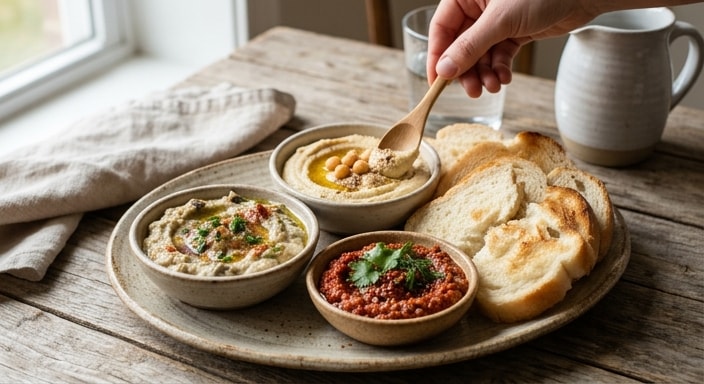
 Mezze-Trio mit warmem Weißbrot
Erfasst von @hokkaido | 0 Nutzer mochten dieses Lebensmittel | 0 Nutzer haben dieses Lebensmittel gespeichert
Nährwertangaben
Pro Portion à 330 g
% Tageswert basierend auf einer Ernährung mit 2000 kcal
Kalorien
520 kcal
26% DV
Fett gesamt
26.0g
40% DV
einfach ungesättigte Fettsäuren11.0g
mehrfach ungesättigte Fettsäuren8.0g
gesättigte Fettsäuren3.5g
Kohlenhydrate gesamt
58.0g
19% DV
Ballaststoffe10.0g
Stärke40.0g
Zucker4.0g
Protein
15.0g
30% DV
pflanzliches Eiweiß15.0g
Über
Eine kleine Mezze-Portion mit Babaganoush, Hummus, Adjica und weichem Weißbrot. Mediterran serviert und ideal als Vorspeise oder zum Teilen.
Zutaten
- babaganoush 80g
- Hummus
- adjica 30g
- white fluffy bread 140g
Vitamine & Mineralstoffe
Vitamine
| Nährstoff | Menge | NRV% | Halbwertszeit |
|---|---|---|---|
| Cholin | 35.0mg | 6% | |
| Vitamin A | 180.0mcg | 20% | |
| Thiamin | 0.3mg | 29% | |
| Riboflavin | 0.2mg | 14% | |
| Niacin | 3.5mg | 22% | |
| Pantothensäure | 0.9mg | 18% | |
| Vitamin B6 | 0.3mg | 15% | |
| Biotin | 4.0mcg | 13% | |
| Folat | 90.0mcg | 23% | |
| Vitamin C | 12.0mg | 13% | |
| Vitamin E | 3.0mg | 20% | |
| Vitamin K | 18.0mcg | 15% |
Mineralstoffe
| Nährstoff | Menge | NRV% | Halbwertszeit |
|---|---|---|---|
| Calcium | 90.0mg | 9% | |
| Chrom | 4.0mcg | 11% | |
| Kupfer | 0.3mcg | 0% | |
| Jod | 5.0mcg | 3% | |
| Eisen | 3.2mg | 18% | |
| Magnesium | 55.0mg | 13% | |
| Mangan | 0.9mg | 39% | |
| Molybdän | 12.0mcg | 27% | |
| Phosphor | 180.0mg | 26% | |
| Kalium | 420.0mg | 9% | |
| Selen | 18.0mcg | 33% | |
| Natrium | 720.0mg | 31% | |
| Zink | 1.8mg | 16% |
Mezze-Trio mit warmem Weißbrot
Eine zurückhaltende Mezze-Platte steht und fällt mit der Balance: Rauch, Cremigkeit, Schärfe und Weichheit müssen aufeinandertreffen, ohne einander zu bedrängen. Hier sind Babaganoush, Hummus und Adjica als eigenständige Stimmen angeordnet, während Weißbrot die nötige Zartheit und Trägerfunktion bietet. Das Ergebnis sollte großzügig, klar und stimmig wirken.
Gerichtskategorie: Mezze-Platte
Küche oder Herkunft: Östliches Mittelmeer und vom Kaukasus inspiriert
Gang: Vorspeise oder kleine Platte zum Teilen
Ergibt: 1 Platte
Portionsgröße: 330 g
Vorbereitungszeit: 10 Minuten
Garzeit: 3 Minuten
Gesamtzeit: 13 Minuten
Schwierigkeitsgrad: Einfach
Kleine Servierplatte
Kleiner Löffel
Brotmesser
Toaster oder trockene Pfanne
Drei kleine Serviermulden oder Förmchen, falls gewünscht
Babaganoush 80 g
Hummus 80 g
Adjica 30 g
Weiches Weißbrot 140 g
1. Babaganoush, Hummus und Adjica 10 Minuten lang auf Raumtemperatur kommen lassen, damit ihre Texturen weicher werden und sich ihre Aromen entfalten. Die Dips sollten geschmeidig sein, nicht kalt und fest.
2. Das weiche Weißbrot 2 bis 3 Minuten in einem Toaster oder in einer trockenen Pfanne bei mittlerer Hitze erwärmen, in der Pfanne einmal wenden. Das Brot sollte leicht durchgewärmt, in der Mitte weich und an den Rändern nur ganz leicht knusprig sein, ohne stark zu bräunen.
3. Den Babaganoush in einen Bereich der Servierplatte löffeln und zu einem flachen Oval glattstreichen. Den Hummus daneben setzen und zu einem zweiten sauberen Häufchen oder flachen Bogen formen. Die Adjica in einen dritten, kleineren Klecks löffeln und den Rand sauber und klar abgegrenzt halten.
4. Das warme Brot bei Bedarf in gleichmäßige Stücke schneiden und dann in einer geordneten Linie oder fächerförmig neben den Dips anrichten. Die Platte sollte als drei klare Elemente wirken, nicht als Mischung.
Sofort servieren, solange das Brot warm ist und die Dips geschmeidig bleiben. Die Platte so präsentieren, dass die Dips getrennt sind, aber nah genug beieinander liegen, um leicht von einem zum nächsten zu wechseln. Die endgültige Komposition sollte ausgewogen sein, wobei das Brot als weicher, neutraler Rahmen dient.
Die Dips in Form und Platzierung klar voneinander trennen; visuelle Klarheit ist Teil der Disziplin dieses Gerichts.
Warmes Brot ist essenziell, muss aber zart bleiben. Zu starkes Rösten stört die Balance.
Wenn die Adjica besonders kräftig ist, die Portion kompakt halten, damit sie die Platte schärft, statt sie zu dominieren.
Grundlegendes zum Rezept
Benötigte Utensilien
Zutaten
Mezze-Komponenten
Brot
Zubereitung
Anrichten und servieren
Sofort servieren, solange das Brot warm ist und die Dips geschmeidig bleiben. Die Platte so präsentieren, dass die Dips getrennt sind, aber nah genug beieinander liegen, um leicht von einem zum nächsten zu wechseln. Die endgültige Komposition sollte ausgewogen sein, wobei das Brot als weicher, neutraler Rahmen dient.
Hinweise für Profis
VegetarischMediterranAusgewogen