

Startseite / world / Europa / Schweden / Horiatiki-Salat mit Feta, Oliven und Oregano

Horiatiki-Salat mit Feta, Oliven und Oregano
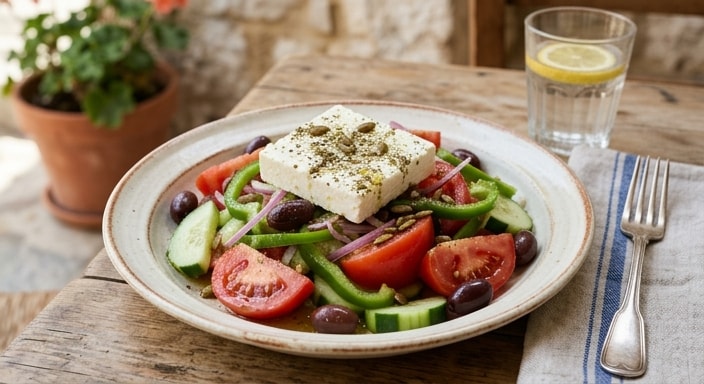
Horiatiki-Salat mit Feta, Oliven und Oregano
Erfasst von @hokkaido | 0 Nutzer mochten dieses Lebensmittel | 0 Nutzer haben dieses Lebensmittel gespeichert

Nährwertangaben

Pro Portion à 340 g

% Tageswert basierend auf einer Ernährung mit 2000 kcal

Kalorien 520 kcal
26% DV
Fett gesamt 44.0g
68% DV
einfach ungesättigte Fettsäuren18.5g
mehrfach ungesättigte Fettsäuren2.5g
gesättigte Fettsäuren20.0g
Transfettsäuren0.8g
Kohlenhydrate gesamt 18.0g
6% DV
Ballaststoffe5.0g
Stärke4.0g
Zucker9.0g
Protein 17.0g
34% DV
tierisches Eiweiß15.0g
pflanzliches Eiweiß2.0g

Über

Ein griechisch inspirierter Salat mit viel Feta, Gurke, grüner Paprika, Tomate, Oliven, Zwiebel, Olivenöl und Oregano. Reich an Fett und Natrium, mit moderatem Proteingehalt und relativ wenig Kohlenhydraten.

Zutaten

Vitamine & Mineralstoffe

Vitamine

NährstoffMengeNRV%Halbwertszeit
Biotin9.0mcg30%
Cholin32.0mg6%
Folat75.0mcg19%
Niacin1.4mg9%
Pantothensäure0.8mg16%
Riboflavin0.8mg62%
Thiamin0.1mg8%
Vitamin A210.0mcg23%
Vitamin B122.0mcg83%
Vitamin B60.3mg18%
Vitamin C52.0mg58%
Vitamin D0.7mcg3%
Vitamin E1.8mg12%
Vitamin K42.0mcg35%

Mineralstoffe

NährstoffMengeNRV%Halbwertszeit
Calcium720.0mg72%
Kupfer140.0mcg16%
Eisen2.2mg12%
Magnesium42.0mg10%
Phosphor430.0mg61%
Kalium520.0mg11%
Selen22.0mcg40%
Natrium1450.0mg63%
Zink3.3mg30%

Horiatiki-Salat mit Feta, Oliven und Oregano

Vorbemerkung


Dies ist der griechische Dorfsalat in seiner genauesten Form: leuchtend, salzig und kompromisslos schlicht. Der Erfolg des Gerichts hängt von der Qualität des Gemüses, der Festigkeit des Fetas und dem maßvollen Einsatz des Olivenöls ab. Nichts wird kaschiert; jedes Element muss klar erkennbar, kühl und lebhaft gewürzt bleiben.

Rezeptübersicht


  • Gerichtskategorie: Salat

  • Küche oder Herkunft: Griechisch

  • Art des Gangs: Vorspeise oder leichte Hauptspeise

  • Ergibt: 1 Portion

  • Portionsgröße: 340 g

  • Vorbereitungszeit: 15 Minuten

  • Kochzeit: 0 Minuten

  • Gesamtzeit: 15 Minuten

  • Schwierigkeitsgrad: Einfach


  • Küchengeräte


  • Kochmesser

  • Schneidebrett

  • Rührschüssel

  • Servierteller


  • Zutaten


  • Feta, 80 g

  • Gurke, 90 g, geschält, falls die Schale zäh ist, in dicke halbe Scheiben geschnitten

  • Grüne Paprika, 35 g, entkernt und in schmale Streifen geschnitten

  • Tomate, 85 g, in Spalten geschnitten

  • Zwiebel, 20 g, sehr dünn geschnitten

  • Oliven, 15 g, entsteint

  • Olivenöl, 12 g

  • Kürbiskerne, 8 g

  • Getrockneter Oregano, 1 g


  • Zubereitung


  • 1. Gurke, grüne Paprika, Tomate, Zwiebel und Oliven in eine Rührschüssel geben. Die Tomaten vorsichtig behandeln, damit sie ihre Form behalten und nicht zu viel Saft abgeben.

  • 2. Den Feta als ganzen Block oder in großen, sauberen Stücken hinzufügen. Der Käse sollte deutlich sichtbar aufliegen, statt im Gemüse unterzugehen.

  • 3. Das Olivenöl gleichmäßig über den Salat träufeln. Das Gemüse sollte leicht glänzen, ohne dass sich Öl sammelt.

  • 4. Die Kürbiskerne über die Oberfläche streuen und mit dem getrockneten Oregano abschließen. Das Aroma sollte klar und kräutrig sein.

  • 5. Nach Wunsch nur einmal sehr leicht vermengen; andernfalls den Salat in seiner Anrichtung belassen. Die endgültige Textur sollte knackig, saftig und klar getrennt bleiben, wobei der Feta intakt bleibt.


  • Anrichten und Servieren


    Den Salat in einer flachen Schüssel oder auf einem großen Teller anrichten, sodass das Gemüse sichtbar bleibt. Den Feta daraufsetzen, mit Öl, Kernen und Oregano vollenden und sofort servieren, solange das Gemüse kalt und der Käse fest ist.

    Hinweise für Profis


    Reife Tomaten verwenden, die noch genügend Struktur haben, um sauber geschnitten zu werden. Die Zwiebel so fein wie möglich schneiden, damit sie dem Salat Schärfe verleiht, ohne ihn zu dominieren. Die Balance muss salzig, frisch und trocken genug bleiben, damit der Salat auf dem Teller in Form bleibt.
    VegetarischMediterranGlutenfreiAusgewogen
    Im App Store laden

    Feel Better.

    OKKAI engine computes your next meal.

    OKKAI dashboard
    Food detail
    OKKAI engine

    One photo.
    Full breakdown.

    Point your camera at any meal — restaurant dish, homemade food, snack, smoothie. OKKAI identifies what you're eating and returns a complete nutritional profile in seconds.

    • ·Calories, protein, carbs, and fat — instantly
    • ·20+ vitamins and minerals estimated per meal
    • ·Works on any meal, any cuisine, anywhere
    • ·Ingredient breakdown with adjustable portions
    • ·Recipe generation from any logged food
    Food nutrition detail

    See what people
    are actually eating.

    Every meal logged by OKKAI users — from Stockholm to Seoul.

    Loading meals…

    Built for people who take
    nutrition seriously.

    Feature screenshot
    The OKKAI engine

    Your body keeps score.

    OKKAI ingests your sleep, exercise, food, weight, age, location and weather data. It breaks food down to its smallest compounds, computes vitamin and mineral half-lives, and models your body's current state as accurately as possible from all available data.

    The OKKAI engine keeps track of what cannot be seen.

    Computed every hour.

    Your body is never static. Vitamins deplete, minerals interact, absorption rates shift with activity and time of day.

    The engine recomputes every hour in order to give a suggestion on what to eat and when.

    Deep Apple Health integration.

    OKKAI reads from and writes to Apple Health — bi-directionally. Every meal pushes macros, vitamins, and minerals into your health record. Every workout and sleep session flows back into OKKAI's analysis.

    Works with Apple Health
    Bi-directional sync
    Certified integration

    Reads from Health

    • Steps
    • Active calories
    • Workouts
    • Weight
    • Sleep hours
    • Resting heart rate

    Writes to Health

    • Dietary calories
    • Protein, carbs, fat
    • Fiber
    • All 13 vitamins
    • All 10 minerals
    Apple Health integration screen

    What people on Instagram say.

    Instagram review
    Instagram review

    Coming very soon.

    OKKAI is launching on iOS shortly. Sign up for the waiting list and be among the first to track nutrition the way it should be tracked.

    Download on the App Store

    Common questions.

    You take a photo of any meal. OKKAI's AI identifies the food, estimates the ingredients, calculates calories and macronutrients, and estimates 20+ vitamins and minerals — all within a few seconds. You can then adjust portions or add ingredients manually.
    Yes — OKKAI tracks 13 vitamins (A, C, D, E, K, B6, B12, folate, and more) and 10 minerals (calcium, iron, magnesium, zinc, potassium, and more). After logging enough meals, OKKAI provides an in-depth analysis of your body's nutrient stores and tells you exactly which foods to eat to fill the gaps.
    OKKAI supports 30+ protocols: daily time-restricted eating (12:12, 14:10, 16:8, 18:6, 20:4, OMAD), multi-day (5:2, alternate day fasting), extended fasts (24h, 36h, 48h, 72h, 96h), and religious fasts including Ramadan. You can also run a custom fast for any duration.
    Yes — deeply. OKKAI reads steps, active calories, workouts, weight, sleep, and resting heart rate from Apple Health. It also writes every meal's calories, macros, fiber, and all micronutrients back to your Health record so your full nutritional data lives in one place.
    OKKAI is free to download. Core features — food logging, calorie and macro tracking, fasting, weight tracking, and Apple Health sync — are free. Advanced AI analysis including the full micronutrient breakdown and personalized recommendations is available with OKKAI Premium.