

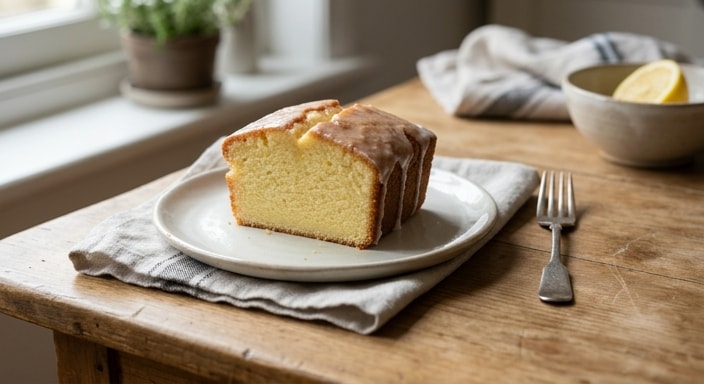
 Plumcake al limone glassato
Registrato da @hokkaido | A 0 utenti è piaciuto questo alimento | 0 utenti hanno salvato questo alimento
Valori nutrizionali
Per porzione da 210 g
% Valore giornaliero basato su una dieta di 2000 kcal
Calorie
760 kcal
38% DV
Grassi totali
35.8g
55% DV
Grassi monoinsaturi11.9g
Grassi polinsaturi2.6g
Grassi saturi18.9g
Grassi trans0.8g
Carboidrati totali
101.2g
34% DV
Fibre2.1g
Amido44.3g
Zuccheri54.8g
Proteine
10.5g
21% DV
Proteine animali4.4g
Proteine vegetali6.1g
Informazioni
Un plumcake dolce e compatto al limone, con la maggior parte delle calorie che proviene da farina raffinata, zucchero e burro. È piuttosto ricco di carboidrati e grassi, con un apporto proteico moderato e poche fibre.
Vitamine e minerali
Vitamine
| Nutriente | Quantità | %VNR | Emivita |
|---|---|---|---|
| Colina | 54.0mg | 10% | |
| Vitamina A | 292.0mcg | 32% | |
| Tiamina (B1) | 0.4mg | 32% | |
| Vitamina B12 | 0.4mcg | 18% | |
| Riboflavina (B2) | 0.3mg | 22% | |
| Niacina (B3) | 3.1mg | 19% | |
| Acido pantotenico (B5) | 0.7mg | 15% | |
| Vitamina B6 | 0.1mg | 3% | |
| Biotina (B7) | 7.8mcg | 26% | |
| Folato (B9) | 78.0mcg | 20% | |
| Vitamina C | 6.8mg | 8% | |
| Vitamina D | 0.5mcg | 3% | |
| Vitamina E | 1.1mg | 7% | |
| Vitamina K | 7.2mcg | 6% |
Minerali
| Nutriente | Quantità | %VNR | Emivita |
|---|---|---|---|
| Calcio | 86.0mg | 9% | |
| Rame | 95.0mcg | 11% | |
| Ferro | 2.9mg | 16% | |
| Magnesio | 18.0mg | 4% | |
| Fosforo | 126.0mg | 18% | |
| Potassio | 132.0mg | 3% | |
| Selenio | 22.0mcg | 40% | |
| Sodio | 412.0mg | 18% | |
| Zinco | 0.9mg | 8% |
Lemon Glazed Loaf Cake
Headnote
This is a restrained, finely balanced lemon loaf cake: tender from butter and oil, structured by flour and egg, and lifted by the clean brightness of lemon. The crumb should be fine and even, never heavy, with a gentle sheen from the glaze and a direct citrus finish. It is a simple cake made exacting by proportion and discipline.
Recipe essentials
Equipment
Ingredients
Cake batter
Lemon finish
Method
Plating and serving
Slice the cake cleanly with a serrated knife and present each piece upright, with the glazed top visible. Serve at room temperature so the crumb remains soft and the lemon character is fully expressed.
Professional notes
Use softened butter, not melted butter, to preserve structure and a refined crumb. Do not overmix once the flour is added; the cake should be tender, not elastic. The glaze must be applied while the cake is warm so it penetrates lightly without making the surface sticky.
Vegetariana