

 Bolo inglês de limão com glacê
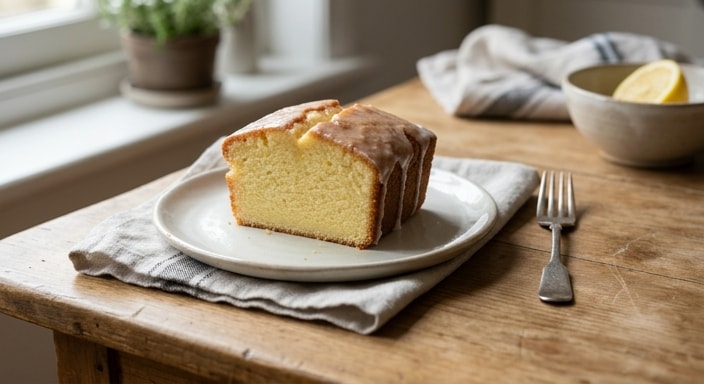
Registado por @hokkaido | 0 utilizadores gostaram deste alimento | 0 utilizadores guardaram este alimento
Informação Nutricional
Por porção de 210g
% Valor Diário com base numa dieta de 2000 kcal
Calorias
760 kcal
38% DV
Gordura total
35.8g
55% DV
Gorduras monoinsaturadas11.9g
Gorduras polinsaturadas2.6g
Gorduras saturadas18.9g
Gorduras trans0.8g
Hidratos de carbono totais
101.2g
34% DV
Fibra2.1g
Amido44.3g
Açúcares54.8g
Proteína
10.5g
21% DV
Proteína animal4.4g
Proteína vegetal6.1g
Sobre
Um bolo inglês de limão denso e doce, em que a maior parte das calorias vem de farinha refinada, açúcar e manteiga. Tem teor relativamente alto de carboidratos e gordura, com proteína moderada e baixo teor de fibra.
Vitaminas e Minerais
Vitaminas
| Nutriente | Quantidade | VD% | Meia-vida |
|---|---|---|---|
| Colina | 54.0mg | 10% | |
| Vitamina A | 292.0mcg | 32% | |
| Tiamina (B1) | 0.4mg | 32% | |
| Vitamina B12 | 0.4mcg | 18% | |
| Riboflavina (B2) | 0.3mg | 22% | |
| Niacina (B3) | 3.1mg | 19% | |
| Ácido pantoténico (B5) | 0.7mg | 15% | |
| Vitamina B6 | 0.1mg | 3% | |
| Biotina (B7) | 7.8mcg | 26% | |
| Folato (B9) | 78.0mcg | 20% | |
| Vitamina C | 6.8mg | 8% | |
| Vitamina D | 0.5mcg | 3% | |
| Vitamina E | 1.1mg | 7% | |
| Vitamina K | 7.2mcg | 6% |
Minerais
| Nutriente | Quantidade | VD% | Meia-vida |
|---|---|---|---|
| Cálcio | 86.0mg | 9% | |
| Cobre | 95.0mcg | 11% | |
| Ferro | 2.9mg | 16% | |
| Magnésio | 18.0mg | 4% | |
| Fósforo | 126.0mg | 18% | |
| Potássio | 132.0mg | 3% | |
| Selénio | 22.0mcg | 40% | |
| Sódio | 412.0mg | 18% | |
| Zinco | 0.9mg | 8% |
Lemon Glazed Loaf Cake
Headnote
This is a restrained, finely balanced lemon loaf cake: tender from butter and oil, structured by flour and egg, and lifted by the clean brightness of lemon. The crumb should be fine and even, never heavy, with a gentle sheen from the glaze and a direct citrus finish. It is a simple cake made exacting by proportion and discipline.
Recipe essentials
Equipment
Ingredients
Cake batter
Lemon finish
Method
Plating and serving
Slice the cake cleanly with a serrated knife and present each piece upright, with the glazed top visible. Serve at room temperature so the crumb remains soft and the lemon character is fully expressed.
Professional notes
Use softened butter, not melted butter, to preserve structure and a refined crumb. Do not overmix once the flour is added; the cake should be tender, not elastic. The glaze must be applied while the cake is warm so it penetrates lightly without making the surface sticky.
Vegetariana