Trang chủ / world / Châu Âu / Thụy Điển / Tonkotsu ramen với chashu, hành lá, gừng ngâm và dầu ớt

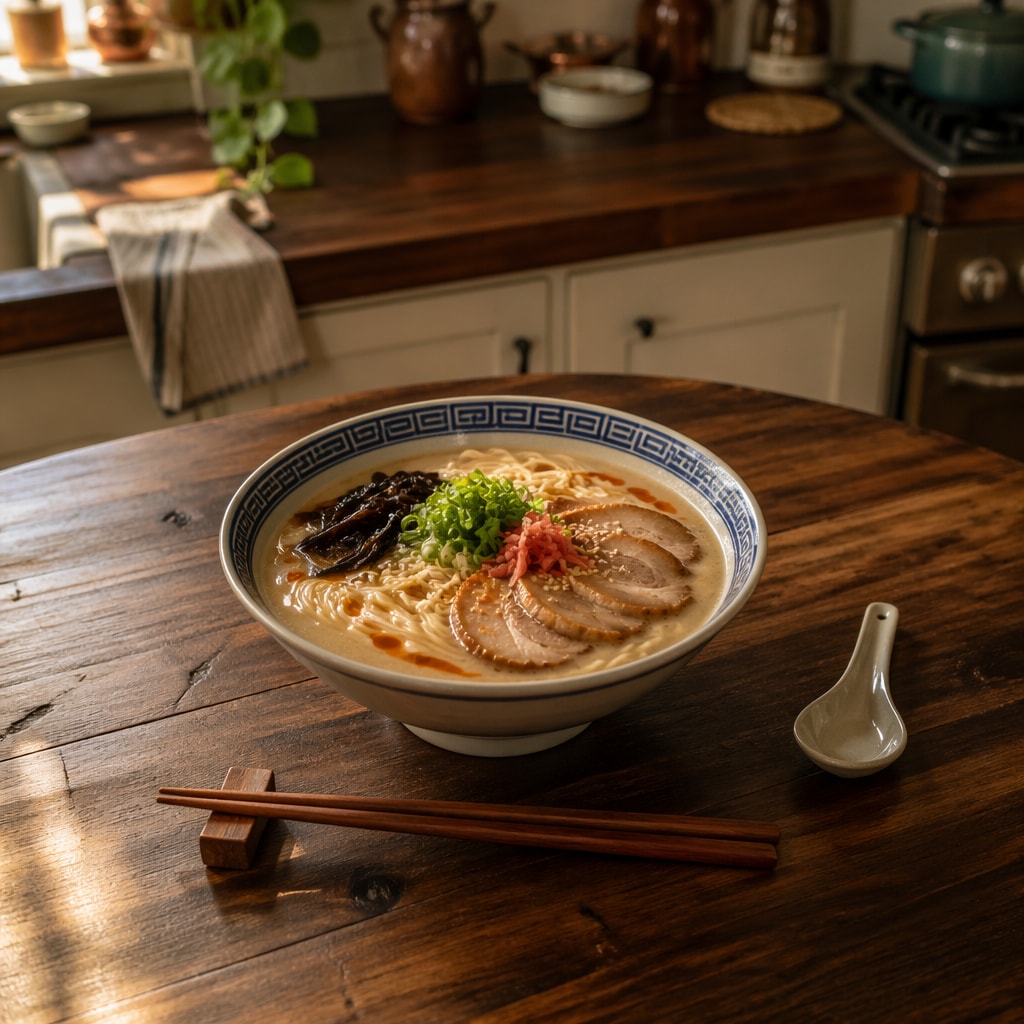
Tonkotsu ramen với chashu, hành lá, gừng ngâm và dầu ớt
Tonkotsu ramen với chashu, hành lá, gừng ngâm và dầu ớt
Được ghi lại bởi @hokkaido | 0 người dùng thích món ăn này | 0 người dùng đã lưu món ăn này

Thông tin dinh dưỡng

Mỗi khẩu phần 620g

% Giá trị hằng ngày dựa trên chế độ ăn 2000 kcal

Calo 760 kcal
38% DV
Tổng chất béo 40.0g
62% DV
Chất béo không bão hòa đơn19.0g
Chất béo không bão hòa đa5.0g
Chất béo bão hòa14.0g
Chất béo chuyển hóa0.2g
Tổng carbohydrate 67.0g
22% DV
Chất xơ4.0g
Tinh bột59.0g
Đường4.0g
Protein 31.0g
62% DV
Protein động vật24.0g
Protein thực vật7.0g

Giới thiệu

A rich pork-broth ramen bowl with wheat noodles and sliced chashu pork. High in sodium and fat, with moderate protein and substantial carbohydrates from the noodles.

Thành phần

Vitamin & Khoáng chất

Vitamin

Dưỡng chấtLượng%DVThời gian bán hủy
Biotin7.0mcg23%
Cholin78.0mg14%
Folat95.0mcg24%
Vitamin B36.8mg43%
Axit pantothenic1.4mg28%
Vitamin B20.4mg32%
Vitamin B10.6mg46%
Vitamin A35.0mcg4%
Vitamin B120.7mcg29%
Vitamin B60.4mg25%
Vitamin C4.5mg5%
Vitamin D0.3mcg2%
Vitamin E1.8mg12%
Vitamin K18.0mcg15%

Khoáng chất

Dưỡng chấtLượng%DVThời gian bán hủy
Canxi85.0mg9%
Đồng220.0mcg24%
Sắt3.2mg18%
Magiê48.0mg11%
Phốt pho290.0mg41%
Kali540.0mg11%
Selen28.0mcg51%
Natri2100.0mg91%
Kẽm2.7mg25%

Tonkotsu Ramen with Chashu, Pickled Ginger, and Chili Oil

Headnote


This is a bowl built on depth, clarity, and control: a milky pork broth, supple noodles, and chashu arranged with precision. Pickled ginger lifts the richness, while chili oil and sesame seed give the finish heat, fragrance, and quiet texture. Every element must remain distinct, yet the bowl should eat as one complete expression.

Recipe essentials


Dish category: Noodle soup
Cuisine or origin: Japanese
Course type: Main course
Yield: 1 bowl
Serving size: 620 g
Prep time: 10 minutes
Cook time: 5 minutes
Total time: 15 minutes
Difficulty: Intermediate

Equipment


1 large saucepan or ramen pot
1 small saucepan for reheating broth and noodles
1 fine strainer or spider
1 ladle
1 serving bowl, 650 g capacity minimum
1 cutting board
1 sharp knife

Ingredients


Broth and noodles


  • 430 g tonkotsu broth

  • 140 g ramen noodle


  • Toppings


  • 60 g pork chashu, sliced

  • 10 g green onion, thinly sliced

  • 8 g pickled ginger

  • 6 g chili oil

  • 4 g wood ear mushroom, prepared

  • 2 g sesame seed


  • Method


  • 1. Bring the tonkotsu broth to a steady simmer in a small saucepan over medium heat. Hold it there for 3 to 4 minutes until fully hot, fragrant, and lightly steaming; do not let it boil hard, or the broth will lose its refined texture.


  • 2. In a separate pot, cook the ramen noodle in rapidly boiling water for 1 minute 30 seconds to 2 minutes, or according to the point at which the noodle is just tender with a firm core. Stir once or twice to prevent sticking, then drain thoroughly.


  • 3. Warm the pork chashu in the hot broth for 30 to 45 seconds, just long enough to take the chill off without tightening the meat. The slices should remain glossy and supple.


  • 4. Place the wood ear mushroom in the serving bowl. Add the drained noodle to the center, then arrange the chashu neatly over one side of the bowl.


  • 5. Ladle the hot tonkotsu broth over the noodles and toppings, using the full 430 g. The broth should surround the noodles completely and pool with a pale, opaque sheen.


  • 6. Finish with the green onion, pickled ginger, chili oil, and sesame seed, placing each with intention so the surface remains balanced and readable. Serve immediately while the broth is hot and the noodles retain their spring.


  • Plating and serving


    Serve in a deep bowl with the chashu partially exposed, the green onion concentrated at the crown, and the chili oil drifting across the surface. The finished bowl should feel rich but composed, with brightness and heat cutting through the broth’s weight.

    Professional notes


    Keep the broth hot enough to carry aroma, but never aggressively boiling at the table. The noodle must be drained well before assembly so the broth stays concentrated. The pickled ginger should remain a finishing accent, not a dominant note.
    Cân bằng

    Tải xuống trên App Store

    Feel Better.

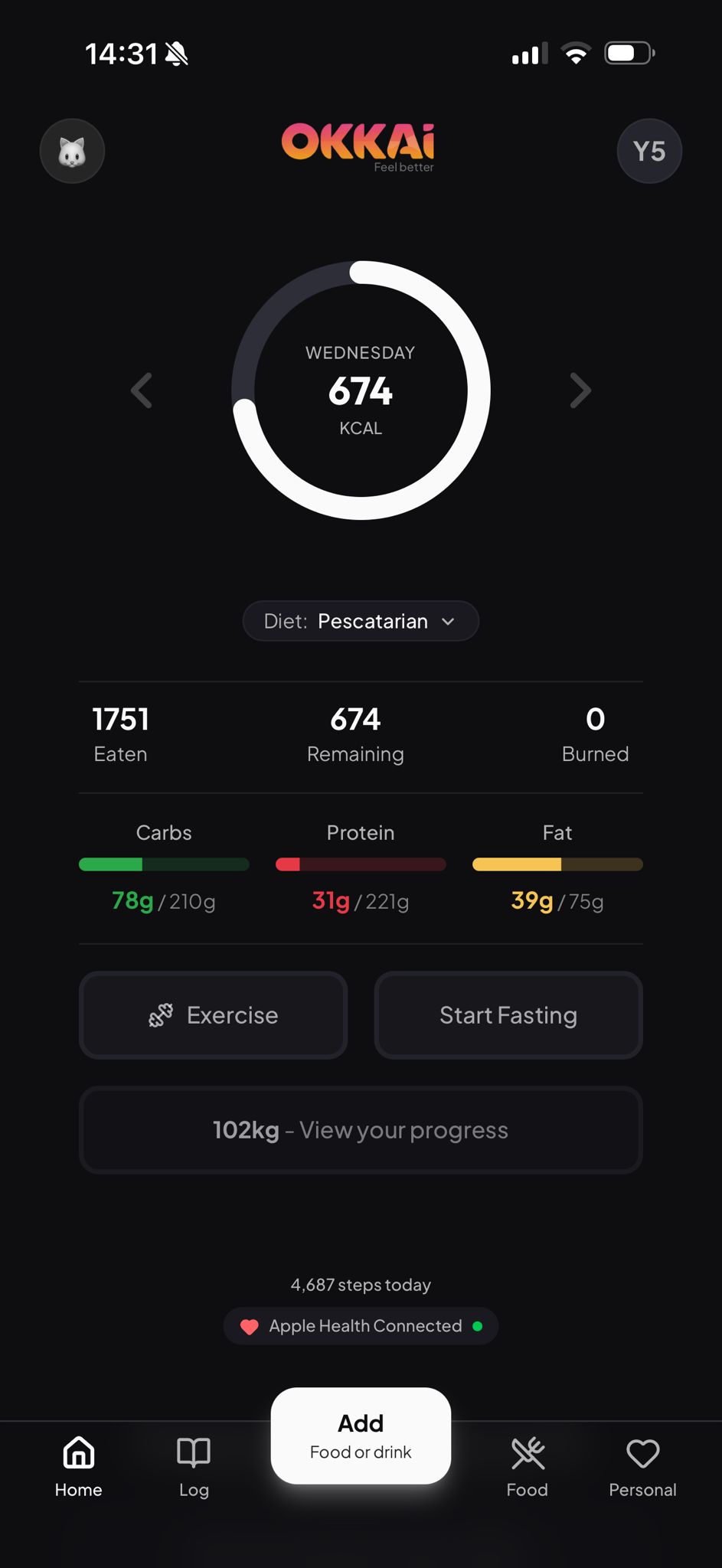
    OKKAI engine computes your next meal.

    OKKAI dashboard
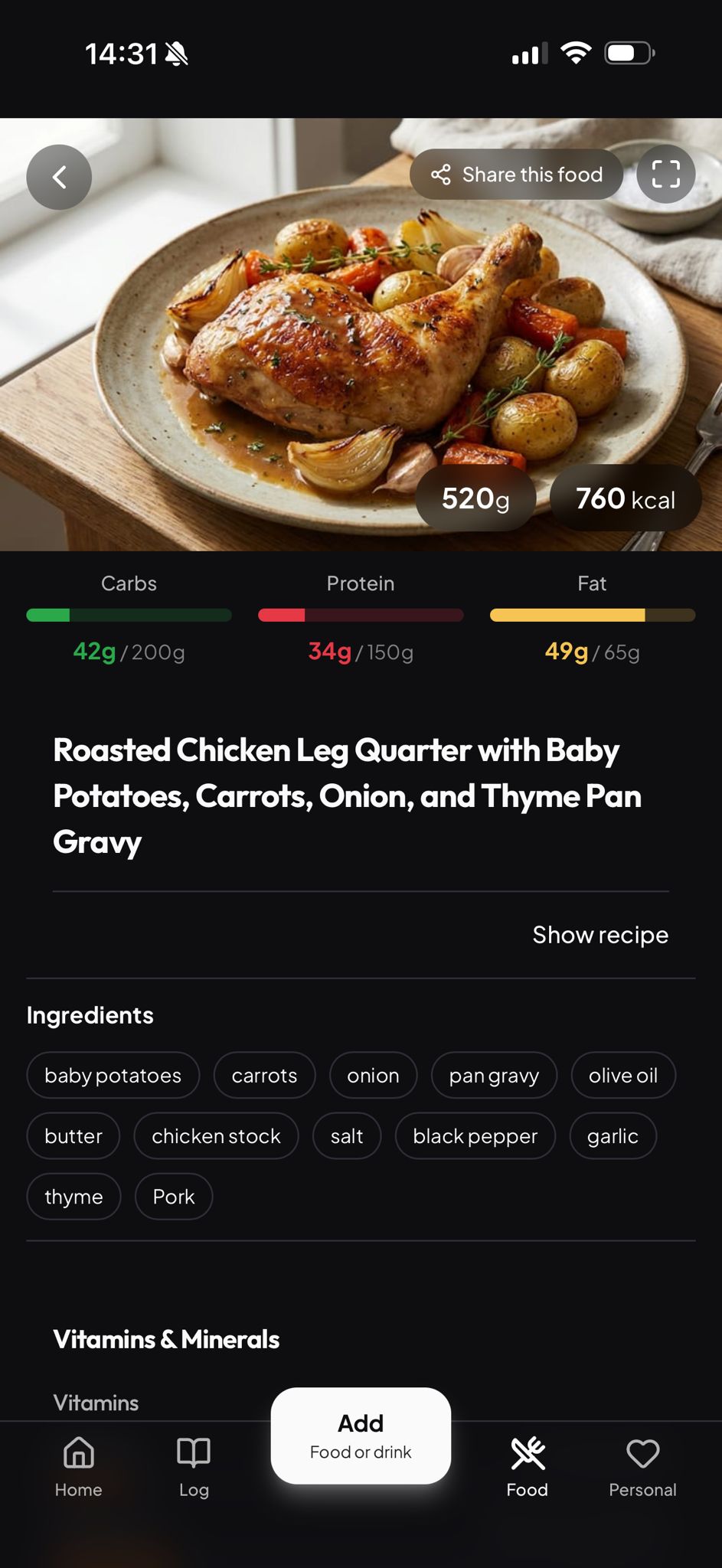
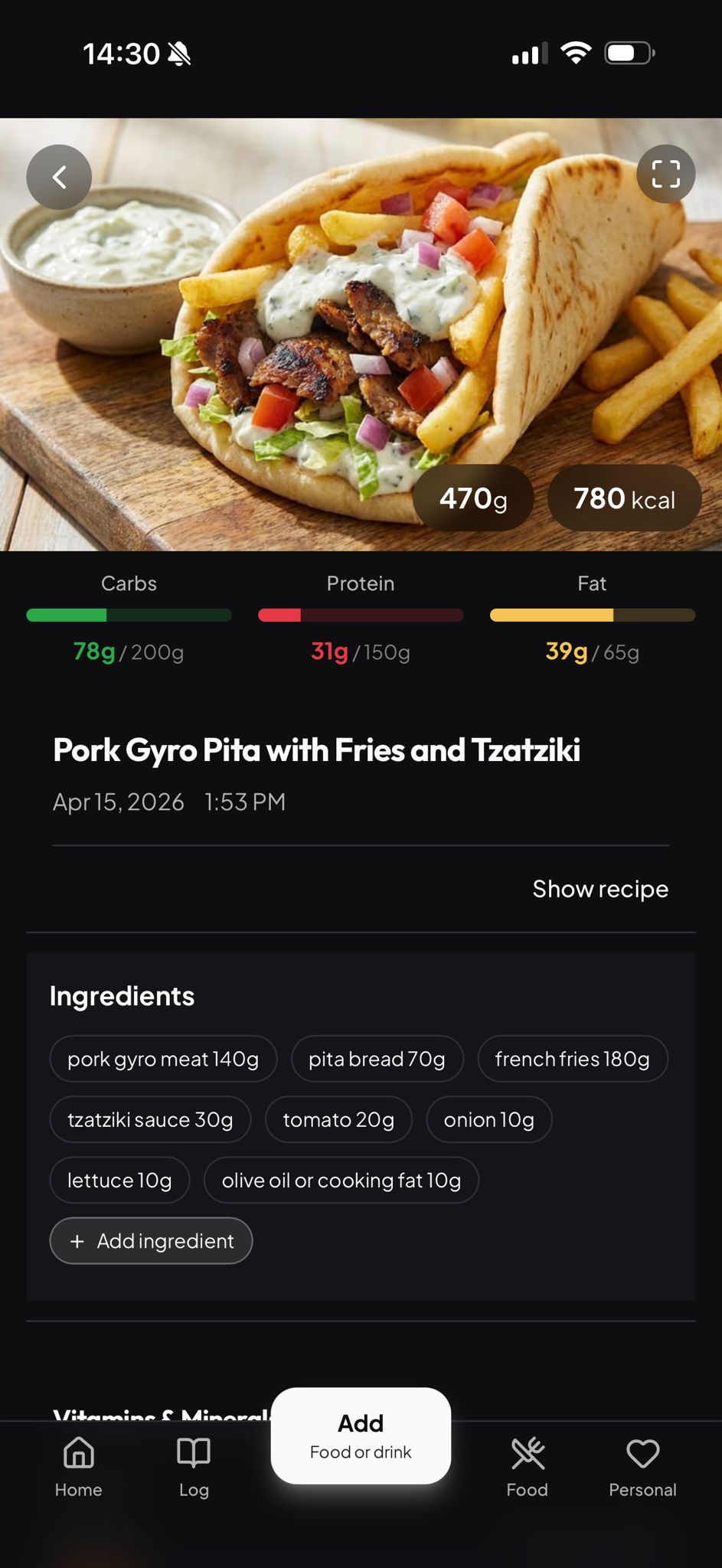
    Food detail
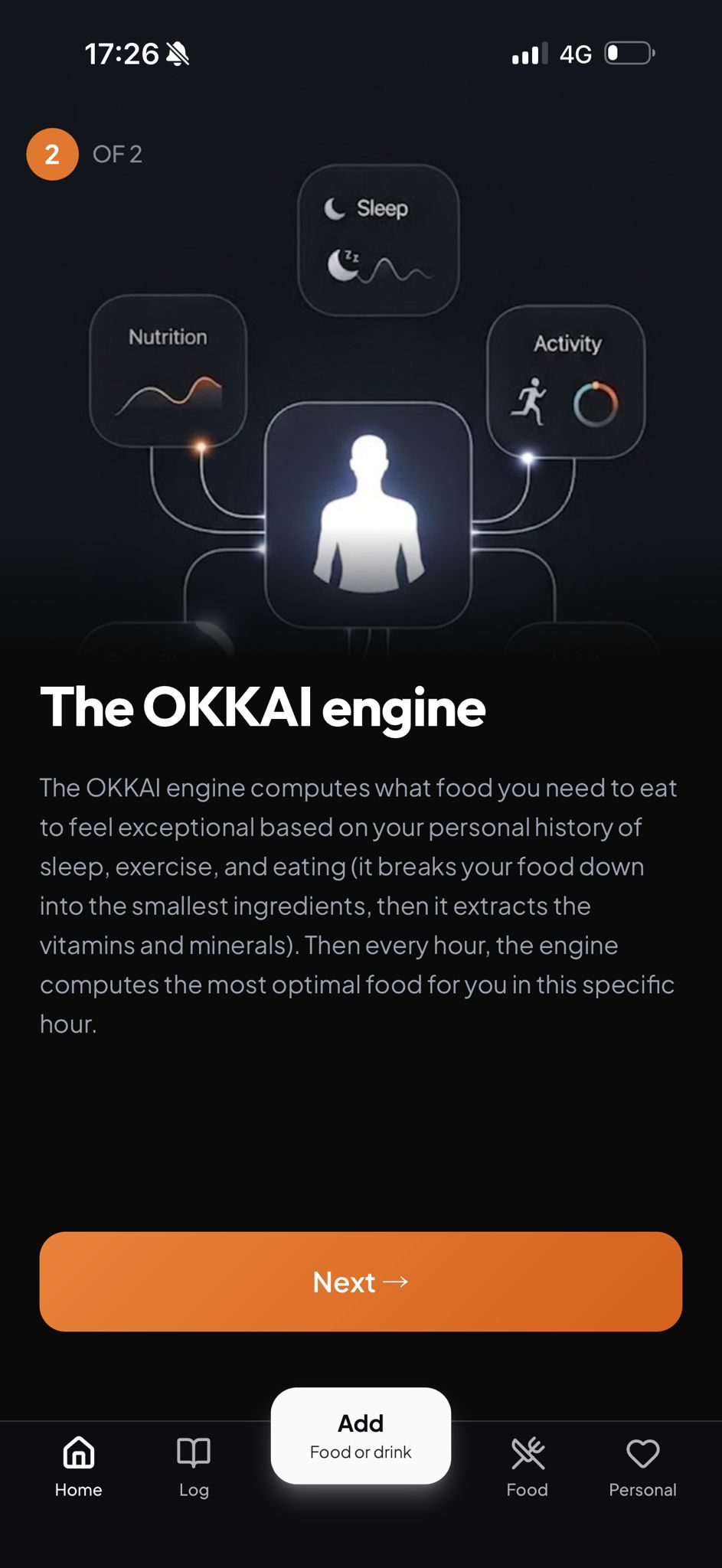
    OKKAI engine

    One photo.
    Full breakdown.

    Point your camera at any meal — restaurant dish, homemade food, snack, smoothie. OKKAI identifies what you're eating and returns a complete nutritional profile in seconds.

    • ·Calories, protein, carbs, and fat — instantly
    • ·20+ vitamins and minerals estimated per meal
    • ·Works on any meal, any cuisine, anywhere
    • ·Ingredient breakdown with adjustable portions
    • ·Recipe generation from any logged food
    Food nutrition detail

    See what people
    are actually eating.

    Every meal logged by OKKAI users — from Stockholm to Seoul.

    Loading meals…

    Built for people who take
    nutrition seriously.

    Feature screenshot
    The OKKAI engine

    Your body keeps score.

    OKKAI ingests your sleep, exercise, food, weight, age, location and weather data. It breaks food down to its smallest compounds, computes vitamin and mineral half-lives, and models your body's current state as accurately as possible from all available data.

    The OKKAI engine keeps track of what cannot be seen.

    Computed every hour.

    Your body is never static. Vitamins deplete, minerals interact, absorption rates shift with activity and time of day.

    The engine recomputes every hour in order to give a suggestion on what to eat and when.

    Deep Apple Health integration.

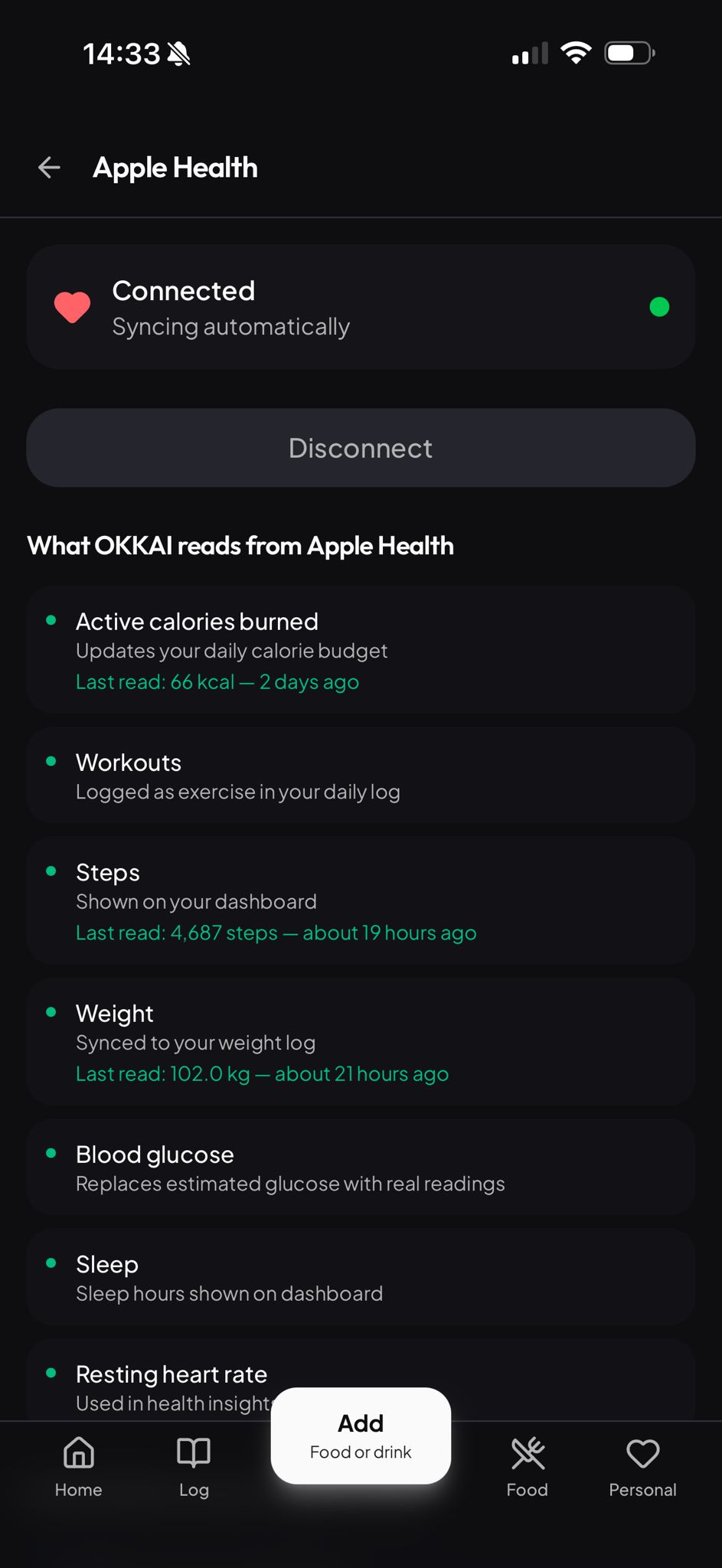
    OKKAI reads from and writes to Apple Health — bi-directionally. Every meal pushes macros, vitamins, and minerals into your health record. Every workout and sleep session flows back into OKKAI's analysis.

    Works with Apple Health
    Bi-directional sync
    Certified integration

    Reads from Health

    • Steps
    • Active calories
    • Workouts
    • Weight
    • Sleep hours
    • Resting heart rate

    Writes to Health

    • Dietary calories
    • Protein, carbs, fat
    • Fiber
    • All 13 vitamins
    • All 10 minerals
    Apple Health integration screen

    What people on Instagram say.

    Instagram review
    Instagram review

    Coming very soon.

    OKKAI is launching on iOS shortly. Sign up for the waiting list and be among the first to track nutrition the way it should be tracked.

    Download on the App Store

    Common questions.

    You take a photo of any meal. OKKAI's AI identifies the food, estimates the ingredients, calculates calories and macronutrients, and estimates 20+ vitamins and minerals — all within a few seconds. You can then adjust portions or add ingredients manually.
    Yes — OKKAI tracks 13 vitamins (A, C, D, E, K, B6, B12, folate, and more) and 10 minerals (calcium, iron, magnesium, zinc, potassium, and more). After logging enough meals, OKKAI provides an in-depth analysis of your body's nutrient stores and tells you exactly which foods to eat to fill the gaps.
    OKKAI supports 30+ protocols: daily time-restricted eating (12:12, 14:10, 16:8, 18:6, 20:4, OMAD), multi-day (5:2, alternate day fasting), extended fasts (24h, 36h, 48h, 72h, 96h), and religious fasts including Ramadan. You can also run a custom fast for any duration.
    Yes — deeply. OKKAI reads steps, active calories, workouts, weight, sleep, and resting heart rate from Apple Health. It also writes every meal's calories, macros, fiber, and all micronutrients back to your Health record so your full nutritional data lives in one place.
    OKKAI is free to download. Core features — food logging, calorie and macro tracking, fasting, weight tracking, and Apple Health sync — are free. Advanced AI analysis including the full micronutrient breakdown and personalized recommendations is available with OKKAI Premium.