
Home / World / Europe / Sweden / Salty Peanut Protein Bar

Salty Peanut Protein Bar
Salty Peanut Protein Bar

Nutrition Facts

Per 60g serving

% Daily Value based on a 2000 kcal diet

Calories 240 kcal
12% DV
Total Fat 9.0g
14% DV
Monounsaturated Fat4.5g
Polyunsaturated Fat1.5g
Saturated Fat3.0g
Total Carbohydrate 24.0g
8% DV
Fiber6.0g
Starch14.0g
Sugars4.0g
Protein 20.0g
40% DV
Animal Protein16.0g
Plant Protein4.0g

About

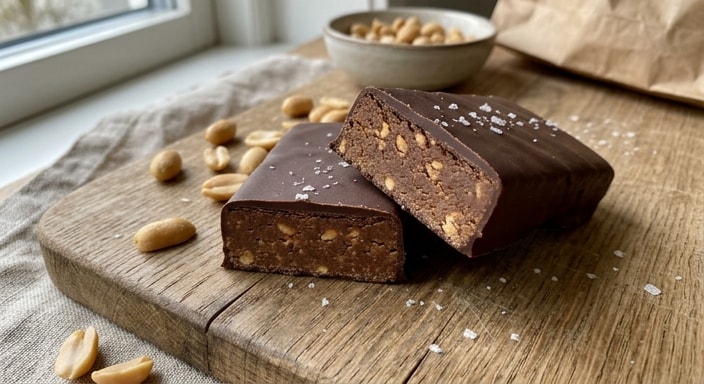
Packaged protein bar with peanuts and chocolate-style coating, high in protein with moderate carbohydrates and fat.

Ingredients

Vitamins & Minerals

Vitamins

NutrientAmountDV%Half-life
Biotin (B7)2.0mcg7%
Choline18.0mg3%
Folate (B9)18.0mcg5%
Niacin (B3)2.4mg15%
Pantothenic Acid (B5)0.6mg12%
Riboflavin (B2)0.2mg14%
Thiamin (B1)0.1mg7%
Vitamin A10.0mcg1%
Vitamin B120.3mcg13%
Vitamin B60.1mg7%
Vitamin D0.2mcg1%
Vitamin E1.2mg8%
Vitamin K2.0mcg2%

Minerals

NutrientAmountDV%Half-life
Calcium140.0mg14%
Copper180.0mcg20%
Iron1.8mg10%
Magnesium55.0mg13%
Phosphorus170.0mg24%
Potassium220.0mg5%
Selenium6.0mcg11%
Sodium210.0mg9%
Zinc1.4mg13%

Salty Peanut Protein Bar

Headnote


This bar is built for clean structure: a dense peanut core, lifted by cocoa and sharpened with salt, then sealed beneath a thin chocolate coating. The chicory root fiber and milk protein blend give it the firm, chewy body expected of a serious protein bar, while glycerin preserves suppleness without softness. It should eat with a controlled bite, not crumble, and finish with a precise balance of sweet, bitter, and saline.

Recipe essentials


  • Dish category: Protein bar

  • Cuisine or origin: Contemporary confectionery

  • Course type: Snack

  • Yield: 1 bar

  • Serving size: 60 g

  • Prep time: 15 minutes

  • Cook time: 10 minutes

  • Total time: 25 minutes

  • Difficulty: Moderate


  • Equipment


  • Small saucepan

  • Heatproof mixing bowl

  • Small silicone spatula

  • Digital scale

  • 60 g bar mold or a small lined rectangular mold

  • Offset spatula or palette knife

  • Refrigerator


  • Ingredients


    Peanut filling


  • Peanut, finely ground or smooth paste: 16 g

  • Milk protein blend: 13 g

  • Chicory root fiber: 11 g

  • Glycerin: 5 g

  • Sugar: 4 g

  • Cocoa powder: 2 g

  • Salt: 0.5 g


  • Coating


  • Chocolate coating: 8.5 g

  • Palm oil: 0.5 g


  • Method


  • 1. Line the mold neatly and set it within easy reach. In a heatproof bowl, combine the peanut, milk protein blend, chicory root fiber, sugar, cocoa powder, and salt. Mix thoroughly until the dry ingredients are evenly distributed and no pale streaks remain.


  • 2. Add the glycerin and work it in with a spatula until the mixture begins to clump. It should become cohesive, slightly glossy, and firm enough to hold together when pressed.


  • 3. Transfer the mixture to the mold. Press it in firmly and evenly, using the flat of the spatula to compact the surface. The bar should be dense, level, and free of gaps. Chill for 10 minutes, until the surface feels set and the bar releases cleanly.


  • 4. Combine the chocolate coating and palm oil in a small saucepan over very low heat. Stir just until melted and smooth, then remove immediately. The coating should be fluid, glossy, and warm, not hot.


  • 5. Unmold the chilled bar and place it on a rack or clean tray. Pour or spread the coating over the bar in a thin, even layer, covering the top fully and allowing a neat edge. Let the coating set at room temperature or chill briefly until firm and matte.


  • Plating and serving


    Serve the bar whole or cut cleanly on the diagonal to reveal the dense interior. The finish should be sleek and restrained, with the chocolate shell intact and the peanut core compact beneath it.

    Professional notes


  • Compact the filling with decisive pressure; insufficient compression will produce a crumbly bar.

  • Keep the coating thin. A heavy shell will dominate the texture and mute the peanut character.

  • The salt must be fully dispersed in the dry mix to avoid sharp pockets.
  • Gluten-freeBalanced
    Download on the App Store

    Feel Better.

    OKKAI engine computes your next meal.

    OKKAI dashboard
    Food detail
    OKKAI engine

    One photo.
    Full breakdown.

    Point your camera at any meal — restaurant dish, homemade food, snack, smoothie. OKKAI identifies what you're eating and returns a complete nutritional profile in seconds.

    • ·Calories, protein, carbs, and fat — instantly
    • ·20+ vitamins and minerals estimated per meal
    • ·Works on any meal, any cuisine, anywhere
    • ·Ingredient breakdown with adjustable portions
    • ·Recipe generation from any logged food
    Food nutrition detail

    See what people
    are actually eating.

    Every meal logged by OKKAI users — from Stockholm to Seoul.

    Loading meals…

    Built for people who take
    nutrition seriously.

    Feature screenshot
    The OKKAI engine

    Your body keeps score.

    OKKAI ingests your sleep, exercise, food, weight, age, location and weather data. It breaks food down to its smallest compounds, computes vitamin and mineral half-lives, and models your body's current state as accurately as possible from all available data.

    The OKKAI engine keeps track of what cannot be seen.

    Computed every hour.

    Your body is never static. Vitamins deplete, minerals interact, absorption rates shift with activity and time of day.

    The engine recomputes every hour in order to give a suggestion on what to eat and when.

    Deep Apple Health integration.

    OKKAI reads from and writes to Apple Health — bi-directionally. Every meal pushes macros, vitamins, and minerals into your health record. Every workout and sleep session flows back into OKKAI's analysis.

    Works with Apple Health
    Bi-directional sync
    Certified integration

    Reads from Health

    • Steps
    • Active calories
    • Workouts
    • Weight
    • Sleep hours
    • Resting heart rate

    Writes to Health

    • Dietary calories
    • Protein, carbs, fat
    • Fiber
    • All 13 vitamins
    • All 10 minerals
    Apple Health integration screen

    What people on Instagram say.

    Instagram review
    Instagram review

    Coming very soon.

    OKKAI is launching on iOS shortly. Sign up for the waiting list and be among the first to track nutrition the way it should be tracked.

    Download on the App Store

    Common questions.

    You take a photo of any meal. OKKAI's AI identifies the food, estimates the ingredients, calculates calories and macronutrients, and estimates 20+ vitamins and minerals — all within a few seconds. You can then adjust portions or add ingredients manually.
    Yes — OKKAI tracks 13 vitamins (A, C, D, E, K, B6, B12, folate, and more) and 10 minerals (calcium, iron, magnesium, zinc, potassium, and more). After logging enough meals, OKKAI provides an in-depth analysis of your body's nutrient stores and tells you exactly which foods to eat to fill the gaps.
    OKKAI supports 30+ protocols: daily time-restricted eating (12:12, 14:10, 16:8, 18:6, 20:4, OMAD), multi-day (5:2, alternate day fasting), extended fasts (24h, 36h, 48h, 72h, 96h), and religious fasts including Ramadan. You can also run a custom fast for any duration.
    Yes — deeply. OKKAI reads steps, active calories, workouts, weight, sleep, and resting heart rate from Apple Health. It also writes every meal's calories, macros, fiber, and all micronutrients back to your Health record so your full nutritional data lives in one place.
    OKKAI is free to download. Core features — food logging, calorie and macro tracking, fasting, weight tracking, and Apple Health sync — are free. Advanced AI analysis including the full micronutrient breakdown and personalized recommendations is available with OKKAI Premium.